

Loading
Sell courses, downloads, calls, events and brand deals — paid to your Nigerian bank.
Fees are non-refundable. Only pay here on Koseisa. We can't help with money sent anywhere else.
This product includes:
Share this product:
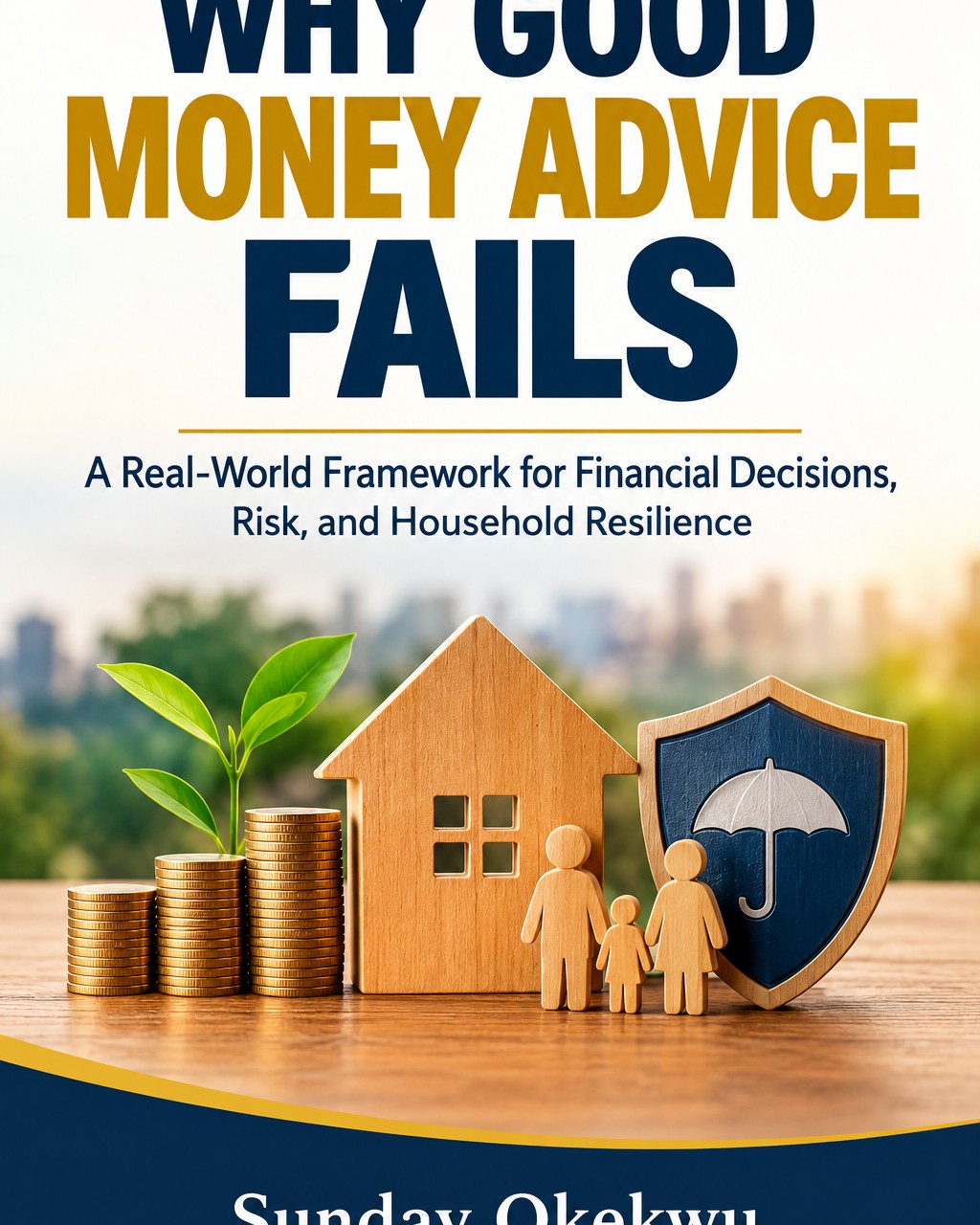
WHY GOOD MONEY ADVICE FAILS A Real-World Framework for Financial Decisions, Risk, and Household Resilience Financial advice is often presented as a collection of principles for earning, saving, investing and managing money. Yet, despite the availability of financial education, professional guidance and investment opportunities, many individuals struggle to translate financial recommendations into sustainable financial outcomes. Why does advice that appears reasonable in theory sometimes fail when applied to real household circumstances? In Why Good Money Advice Fails, Sunday Okekwu examines the structural, economic and behavioural conditions that influence the effectiveness of personal financial decisions. The book challenges the assumption that sound financial recommendations automatically produce sound financial outcomes, arguing that the effectiveness of financial advice depends significantly on the financial circumstances, obligations, resources and risk exposures of the individuals expected to implement it. The analysis explores the relationship between household income structures, competing financial commitments, liquidity requirements, investment decisions, financial protection and long-term wealth preservation. It considers how recommendations that overlook these interconnected factors can expose households to financial instability, interrupt wealth accumulation and undermine otherwise reasonable financial plans. A central contribution of this work is its examination of the gap between financial advice and household financial reality. It shifts attention from simply asking whether a financial recommendation is theoretically correct to examining whether the household has the financial capacity, institutional support and risk-management arrangements required to implement and sustain it. The book provides an analytical perspective on: The limitations of conventional personal finance recommendations. The relationship between household financial structure and decision-making. Why income growth does not automatically translate into financial stability. How competing financial obligations affect savings and investment decisions. The consequences of inadequate financial protection. The interaction between investment risk, liquidity and household resilience. Why financial plans must account for changing economic conditions and life responsibilities. The importance of integrating wealth creation, risk management and wealth preservation. By connecting household economics with financial protection and investment decision-making, this book advances a broader understanding of personal financial management: financial success depends not only on the quality of individual decisions but also on the structure within which those decisions operate. It is relevant to financial professionals, insurance practitioners, investment advisers, economists, researchers, students and individuals seeking a deeper understanding of household financial management and sustainable wealth creation. The fundamental proposition of this book is that financial advice should not be evaluated solely by the soundness of its recommendations, but also by its suitability for the financial conditions, risks and obligations of the household expected to act on it.
By Sunday Okekwu
No reviews yet.